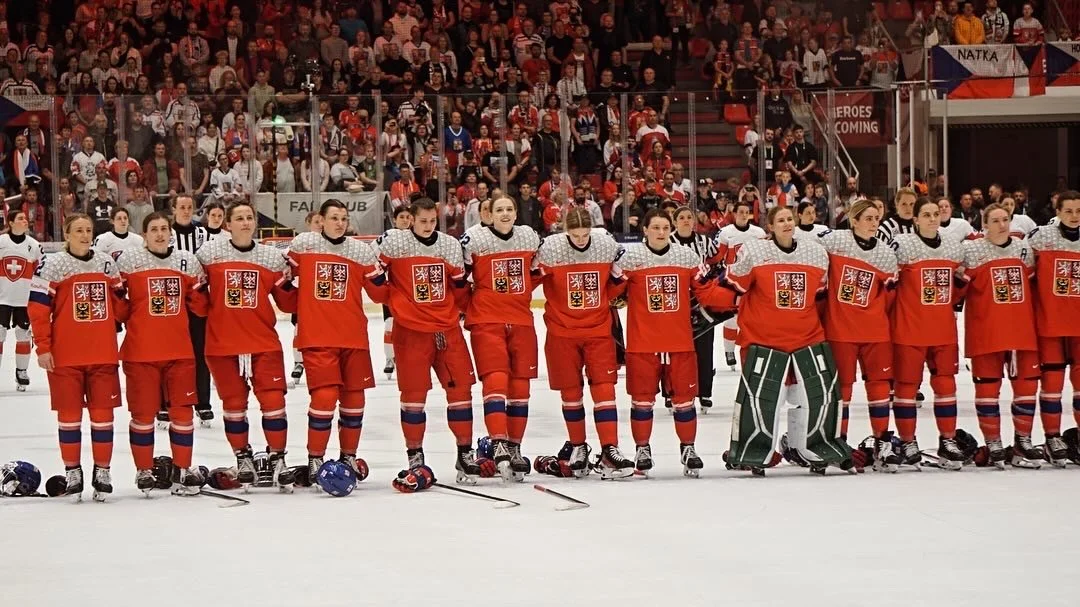
The Cost of Progress: Czechia’s Road to Milan 2026
Progress in women’s hockey is rarely linear. It doesn’t move in leaps so much as in increments, measured not in medals, but expectations. Czechia’s women’s national team has spent the last two seasons living inside those increments. As Milan-Cortina 2026 approaches, the program finds itself in a place that would have seemed improbable not long ago: recent medal success, followed by agonizing near-podium misses, has created - at least on the surface - a mentality where anything short of true contention now feels like a missed opportunity, or worse…failure. That proximity has been earned the slow way, through years of repetition, through narrow victories and brutal disappointment, but also through a steady narrowing of the gap between belief and execution.
This is not a story about arrival. It is a story about staying close long enough that arrival has become inevitable…
Part One: Context - From Participant to Presence
For much of its history, Czech women’s hockey lived in the middle ground of the international game, good enough to be respected, rarely supported enough to be feared. In the early years, Czechia existed largely outside the sport’s main broadcast frame, grinding through the IIHF’s lower tiers where progress is measured in promotions and survivals. The program learned its habits there: structure, stubbornness, the ability to win the games you are supposed to win, and to lose without disappearing. The ascent did not arrive as a single uninterrupted climb, it arrived in waves. Czechia fought up from Division I and, in 2012, won Division I Group A to reach the Top Division, an early breakthrough that proved the ceiling was tangible. The first stay at the top however, was brief. Relegation followed, and with it, the familiar cruelty of women’s international hockey: you can be technically sound and still be structurally very far behind. But what matters in hindsight is not the demotion, it’s the refusal to accept it as a verdict. Czechia rebuilt, and in 2015 earned promotion again, this time not as a cameo.
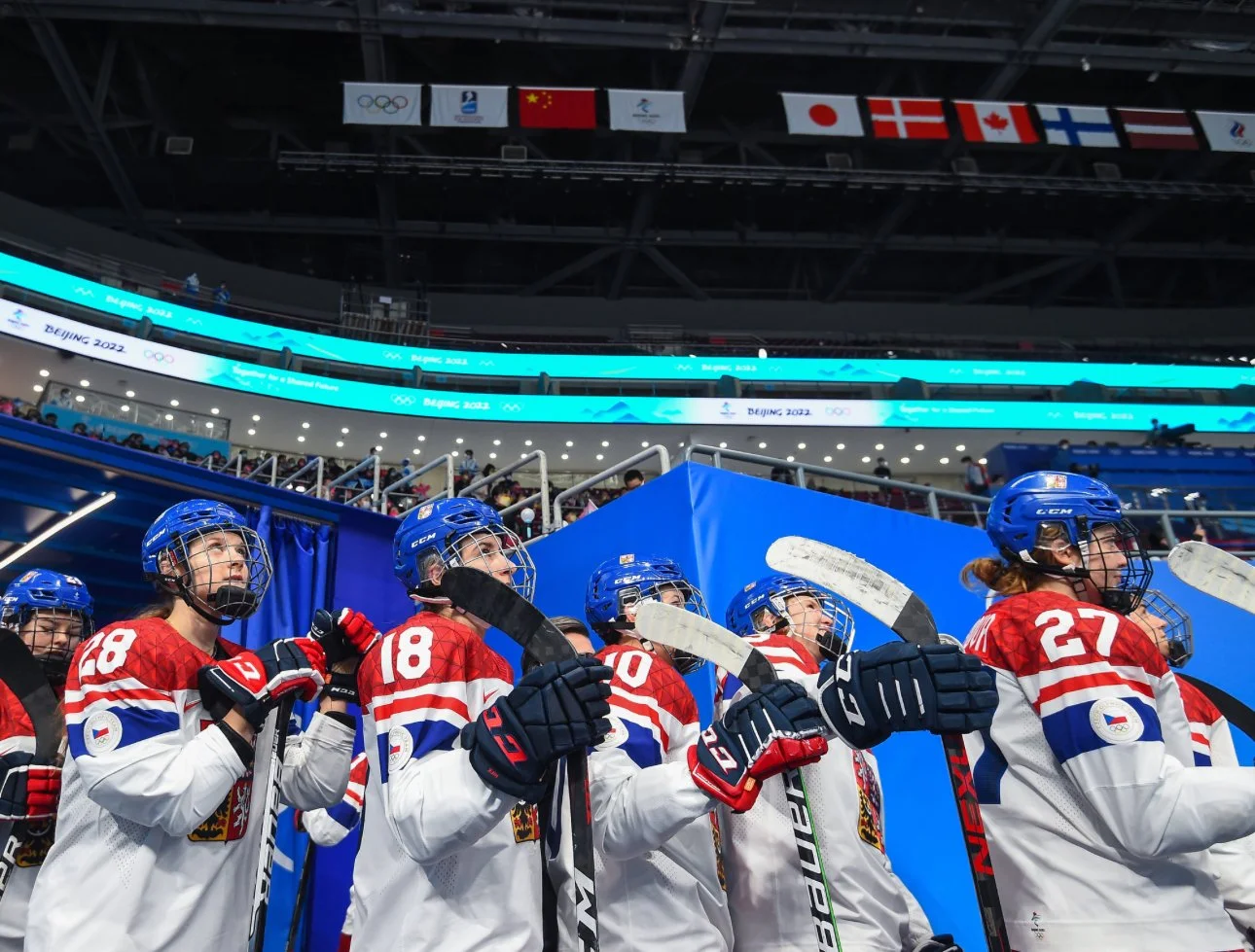
Czechia looks on as it prepares to enter the arena for its first ever Olympic game vs. China (IIHF)
By the time the program qualified for its first Olympic Games in Beijing in 2022, it was no longer a novelty story, it was the product of accumulated seasons, a national team that had learned how to live at the top level rather than merely visit it. The Olympic quarterfinal against the United States became the program’s modern origin point not because of the final score, but because of the experience itself: Czechia scored first, stayed connected to the game deep into it, and forced a comparison that would have once felt premature. The Americans eventually pulled away, but the game did not feel one-sided, for perhaps the first time. It established a reference. From that moment on, Czechia was no longer chasing qualification to events like these.
At the national-team level, continuity mattered. Under former national team head coach Tomáš Pacina, Czechia developed a clear identity rooted in pace, puck possession, and collective responsibility, an insistence that the team would not simply defend and counter, but attempt to play. That philosophy carried through a critical transition, when Carla MacLeod took over and refined rather than replaced it. Where Pacina built structure and belief, MacLeod layered in experience, accountability, and a deeper understanding of what sustained success at the top level actually demands. The handoff was not abrupt in the way some coaching transitions are, instead it was additive.
The results followed. Czechia captured bronze medals at the IIHF Women’s World Championship in both 2022 and 2023, the first senior-level medals in the program’s history. They were not Olympic hardware, but they mattered deeply. They validated the climb and the journey its first group of veterans worked so hard to achieve. They confirmed that Czechia was no longer merely competitive, and that they were capable of finishing.
The 2024 IIHF Women’s World Championship in Utica offered the first sustained look at what this Czech team had become, not just to the broader hockey world, but to us. Our deeper involvement and devoted following of the national program began in earnest after two consecutive bronze medals, historic achievements that we did not experience in real time, but instead inherited in context. We arrived not at the moment of breakthrough, but in its immediate aftermath, riding the momentum of those podium finishes while learning the team through what followed. In some ways, that timing proved clarifying.
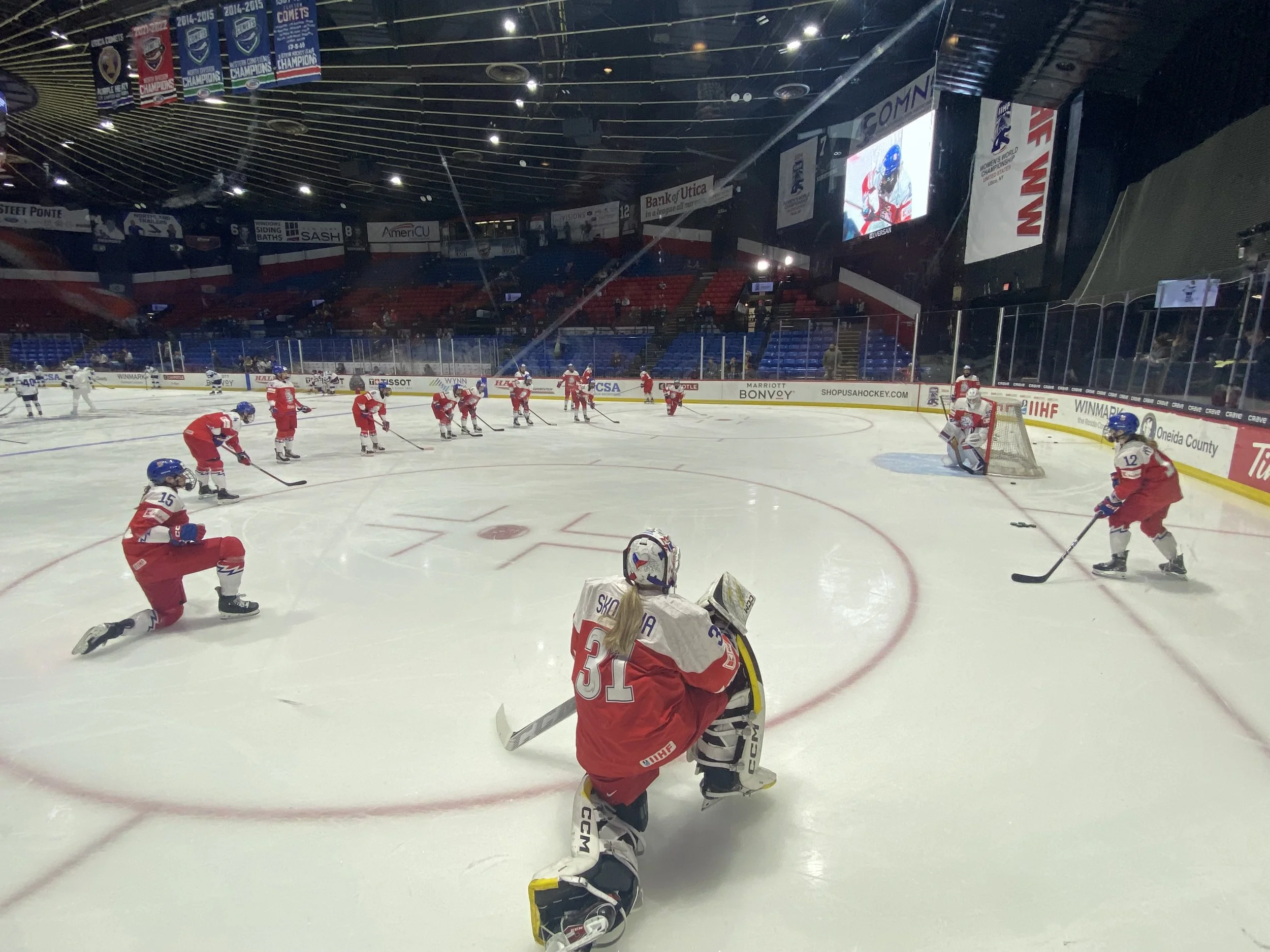
Czechia warms up prior to the bronze medal match vs. Finland at the 2024 Women’s World Championship in Utica, New York (CWHR)
Czechia opened the tournament by overwhelming Switzerland 6-1. The top line of Tereza Vanišová, Natálie Mlýnková, and Denisa Křížová controlled play from the opening shift. Mlýnková recorded a hat trick. Czechia scored twice on the power play. The win was authoritative, and perhaps more importantly, unsurprising. Matches against peers, teams that once represented hurdles, had become expected wins. Over the course of the tournament, Czechia averaged over 30 shots per game against top-tier opposition, a statistical marker of territorial control that would have been unthinkable a decade earlier. No longer surviving on counterattacks or opportunism, they were dictating stretches of play, asserting themselves in ways that separated them from the tier below. The semifinal against Canada exposed the remaining distance. Outshot 47-9 in a 4-0 loss, Czechia struggled to exit its zone and paid for it. But even that game carried a lesson. The Czechs did not unravel. There was no panic, no tactical abandonment, no emotional spillover into the days that followed. They absorbed the result and turned forward, undeterred by loss and still oriented toward what remained.
Peslarová played all 430 minutes of the tournament and was named the IIHF’s best goaltender. Finland’s Michelle Karvinen called her the best goalie at the event. Analysts noted consistently that Czechia’s 2024 side likely surpassed the bronze-medal-winning teams of 2022 and 2023 in overall quality. And while the shootout loss to Finland in the bronze-medal game stung, Utica nonetheless reinforced a growing consensus: Czechia had become the de facto third force in the women’s game. The tournament ended without hardware, but it altered the hierarchy. Czechia was no longer defined by what it lacked. It didn’t NEED the Bronze to feel legitimized in the eyes of the women’s hockey world.
And yet, if Utica was proof of growth and definition, then České Budějovice one year later was exposure fully earned.
Hosting the 2025 World Championship placed Czech women’s hockey in front of its own country in a way it never had before, and at a moment when the program was no longer learning how to compete, but how to carry expectation. This was a home tournament, one year out from Milan, with the world watching and the country leaning in. The arenas filled not out of novelty, but out of investment. Fans traveled across Bohemia, Moravia, and Silesia, turning games into destinations rather than curiosities. Attention was sustained, not fleeting. The games carried national weight, and with it, national pressure. For a program still young in its top-tier identity, it mattered as much as any victory.
The quarterfinal against Switzerland ended quickly, almost violently so. Five goals in the first period. Seven in total. Natálie Mlýnková scored three. Kristýna Kaltounková and Tereza Vanišová each recorded a goal and two assists. This was a team riding unstoppable momentum, one capable of overwhelming an opponent through depth and structure. In many respects, it epitomized the kind of dominance fans had come to expect.
The semifinal against the United States offered a different kind of measure. Czechia scored first (again). They held structure. They stayed within one goal until the final minutes. Inside Budvar Arena, the unthinkable briefly took shape, the collective pause of “what if?” before reality reasserted itself. The eventual 2-1 loss felt less like a ceiling, more a reminder of the distance still to travel, but also of how much had already been covered. In previous cycles, games like this had broken open early. This one did not.
However, the bronze-medal game against Finland was where the tournament shifted from celebration to reckoning. Czechia led 3-0. Goals from Kaltounková, Mlýnková, and Dominika Lásková (returning from an almost career-ending injury) pushed the building into full on belief and exuberance. This was the moment when outcome began to intrude on process, when expectation became tangible enough to weigh on the ice. Then the margins, the same margins Czechia had so often mastered in years past asserted themselves in the opposite direction. Penalties crept in. Finland capitalized. The lead disappeared not all at once, but incrementally. The game moved to overtime. Finland won 4-3.
Statistically, the loss was defined by details: penalties taken under pressure, power-play goals conceded, a shift-by-shift tightening that Finland exploited with composure and experience. Emotionally, it was defined by silence, the kind that follows not disbelief, but recognition. Afterward, Czech players did not deflect responsibility. Lásková spoke openly about nerves. Denisa Křížová credited Finland’s resilience. The honesty was notable and revealing.
What these two tournaments also clarified was the shape and perception of a rivalry. Consecutive bronze-medal games against Finland, both decided beyond regulation, have created a current that now runs through the upper tier of the women’s game. For years, Finland occupied the space Czechia now claims: the established challenger, the most likely to disrupt the North American duopoly. The narrative would suggest a battle between equals. But look closely at territorial play, at consistency against peers, at depth across the lineup, and a different picture emerges. Regardless of individual outcomes, Czechia has moved ahead. Not dramatically. Decisively. Regardless of those two results.
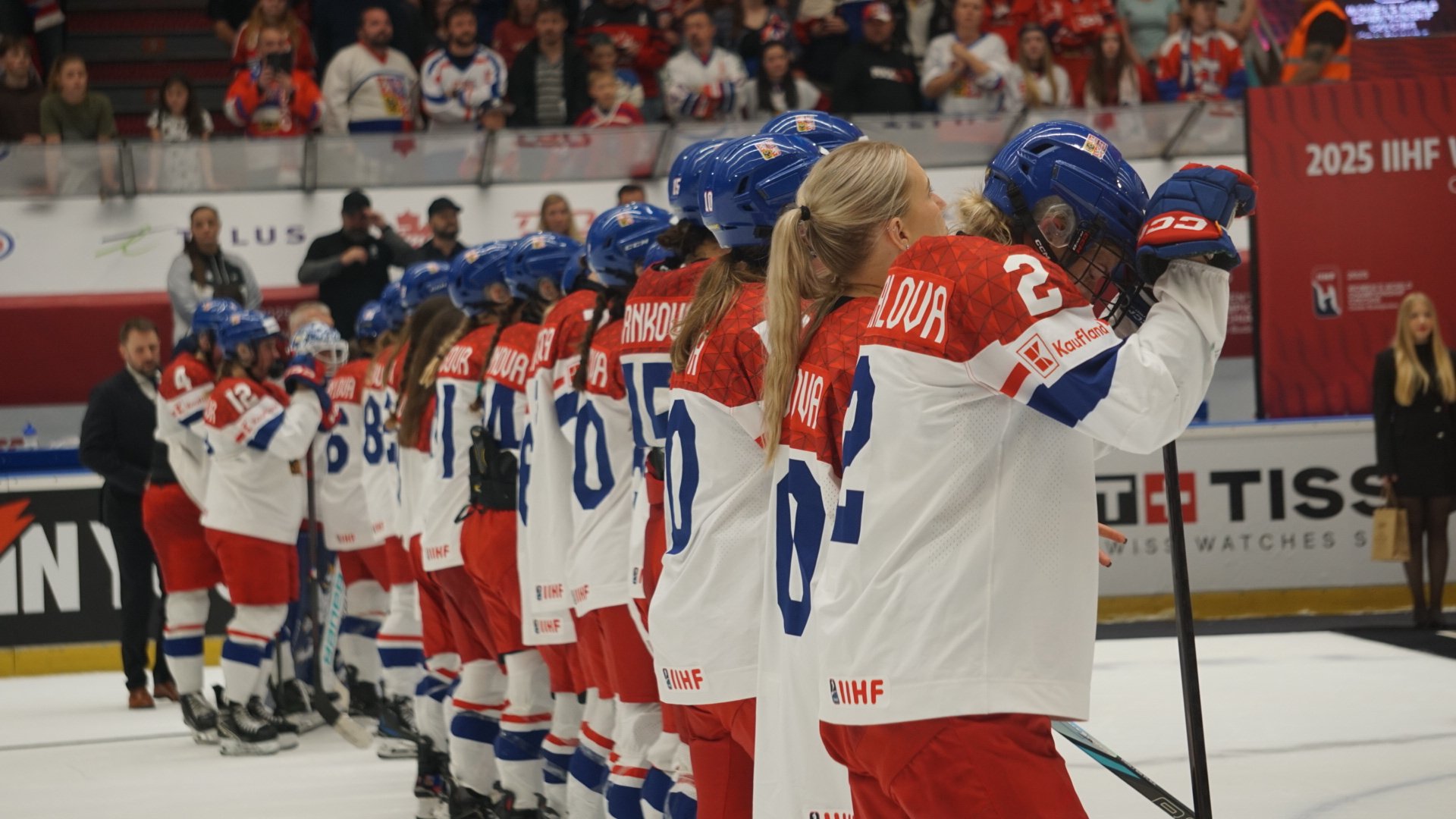
A defeated Team Czechia looks on at the Bronze Medal ceremony following their OT loss to Finland at the 2025 IIHF Women’s World Championship (CWHR)
But to reduce České Budějovice to the absence of a medal is to misunderstand what actually happened there. For a program entering an Olympic year, hosting the World Championship was never just about finishing third instead of fourth. It was about learning how it feels when expectation turns inward, when the pressure is not applied by opponents, but by belief. It was about discovering how thin the line is between playing freely and playing carefully, and how quickly the game punishes hesitation at this level. Those who placed all of the weight of judgment on Utica or České Budějovice, on bronze versus fourth, on podium versus silence, missed the larger movement underneath. They mistook the outcome for the lesson. The truth is that Czechia did not fail those tournaments; it withstood them. And in doing so, it crossed a threshold that cannot be measured in medals.
This was no longer a team learning how to lose at this level.
It was a team learning how to win and learning what happens when it doesn’t.
For us, arriving into full coverage of the national program during these near-misses rather than the bronze-medal years sharpened the lens. We did not inherit the euphoria of the podium; we inherited the questions that followed it. In doing so, we learned the team not through celebration, but through response, through how it has handled disappointment, expectation, and the understanding that it now belonged in rooms where margins decide everything…
Part Two: Czechia at the Edge of Milan
One of Czechia’s quiet advantages heading into Milan is that its emergence has been observed rather than rushed. This team did not materialize in a single cycle, nor did it hinge on a singular breakthrough player. Its rise has been layered, deliberate, and, most importantly, shared across generations.
The development arc of players like Kristýna Kaltounková and Natálie Mlýnková reflects that process. Kaltounková’s selection first overall in the 2025 PWHL Draft came as no surprise to anyone who had followed her progression through Colgate and her dominance of the NCAA. For years analysts, writers, and fans of the women’s game alike pondered on her absence with the national program and ongoing narrative around prioritizing her personal and spiritual development over her national team development. At her long anticipated debut at the 2025 World Championship, she combined physicality and finishing with a composure that suggested not arrival, but the readiness she spent years refining, earning all-star recognition and leading Czech forwards in scoring. Mlýnková, already an Olympian, solidified her place as a first-line international forward across the 2024 and 2025 tournaments. Her two World Championship hat tricks against Switzerland were not anomalies, but instead confirmations of a player who had learned to convert opportunity.
Adéla Šapovalivová represents the next curve of that development. At 18, she left Sweden for the University of Wisconsin and so far has produced immediately. Her dominance at the 2025 U18 World Championship (nine goals, two assists, tournament MVP) was not an endpoint, but an entry point. By the Euro Hockey Tour, she was scoring against senior national teams with a confidence that reflected preparation rather than audacity. Behind and alongside them exists a deeper structure. Players like Tereza Plosová, Daniela Pejšová, and Klára Hymlárová have filled roles that previous Czech teams often lacked the depth to support, secondary scoring, puck movement, matchup reliability, minutes that matter even when they do not headline. This is not a top-heavy roster built around a narrow window. It is a layered one, as capable of absorbing injury, rotation, and pressure. But none of this growth occurred in isolation. It has been anchored by a veteran core that carried Czech women’s hockey through its most transitional years.
Players like captain Aneta Tejralová, Denisa Křížová, Klára Peslarová, and Kateřina Mrázová did not simply arrive to find a functioning program. They helped build it. They guided the team through its first sustained period in the IIHF’s top tier, through its first Olympic appearance, through the shift from outsider to contender. They managed expectations as they rose, and have steadied the room when success threatened to outrun process. Their role has been immense: performing at the highest level while mentoring a generation that arrived under far greater scrutiny than they themselves once faced. They carried the weight of identity formation, what this team would be, how it would play, how it would respond to pressure, and in doing so created the environment into which the next wave could step without having to invent everything from scratch.
The emergence of the PWHL has reinforced that continuity. Beyond elevating competition, the league has normalized excellence. Players now train and compete in environments that mirror international finals on a weekly basis. Crucially, it has also created shared space: veterans and emerging players skating alongside one another, learning within the same professional rhythms. The league’s Takeover Tour game in Washington, D.C., drawing over 17,000 fans, the largest in-arena women’s hockey crowd in U.S. history, was not just a milestone for visibility. It was a signal that the women’s game has entered a phase where legitimacy is assumed, not requested. Czech players have been part of that outward demonstration. They are not passengers in this moment they are contributors. The effect on the national team is tangible. Camps arrive faster. Decisions are sharper. The gap between domestic preparation and international execution has narrowed. The game has sped up, and Czechia has not been left behind.
On top of all of this, the Women’s Euro Hockey Tour now occupies a different role within that ecosystem. Its importance as a competitive platform remains, but Czechia no longer needs to win it to prove legitimacy. Instead, it has become a space for experimentation, for exposure, for promotion of youth within a controlled environment. Early-season tournaments have offered extended looks to younger players. Olympic-year events have forced difficult, but necessary choices about workload, chemistry, and long-term planning. This is not a sign of diminished ambition. It is a sign of maturity. This is how established programs behave.
———-
If Czechia is to medal in Milan, the requirements are now crystal clear. They must close the games they lead. They must manage discipline when pressure peaks. They must convert power plays against elite opponents. They must finish chances that appear once or twice a period. These are not philosophical challenges. They are technical ones. Elite teams in tight games solve them. It is what separates champions from a deflated “…almost”.
The foundation is there: elite goaltending, leadership across age groups, depth scoring, and a system that holds up under scrutiny. What remains is execution in moments that no longer feel unfamiliar. Czechia’s presence at Milan-Cortina is not a culmination. It is a proof point of what sustained investment, professional opportunity, and belief can produce in women’s hockey. For the sport as a whole, Czechia stands as evidence that the international game is deepening, that excellence is no longer confined to a narrow geography, and that growth, when supported, compounds. For Czechia, the meaning is more intimate and more profound.
For an entire generation of players, those who carved this path, and those now growing up inside it these Olympics represent a defining moment. Not because of what might be won, but because of what has already been built: a formal youth pipeline, increased investment, and a national-team leadership structure that increasingly resembles the most successful organizations in the sport.
Whatever happens in Milan, this team has already shifted the ground beneath it. The margins are even thinner now. The expectations even heavier.
That is the cost of progress.
And the clearest sign that this moment decades in the making…..is real.
Article Written By: Preston Huntington - Founder CWHR