Ivo Mocek: Team Czechia’s New Asst. Coach and His Vision for the Next Era of Czech Women’s Hockey
When Ivo Mocek looks back on the path that brought him back to Czech hockey, he does not describe it as a perfectly mapped-out career plan. Instead, he describes it much more simply.
“Don’t say no to opportunities.”
That mindset has carried him to many corners of the hockey world and his resume shows it. He has spent time in Canadian juniors, played professionally in Czechia, England, and the U.S., and coached various youth programs and professional teams across North America and China.
Now he’s back with Czech hockey in one of the most important roles in the country’s women’s hockey program. For many fans, especially those who may follow the Czech women’s national team, Mocek may not yet be a familiar name. But his new role is not simply that of an assistant coach standing behind the senior national team bench. When Czech Hockey announced its new women’s national team staff, Brian Idalski was named head coach of the senior team. Mocek, meanwhile, was named assistant coach of the senior national team and ‘šéftrenér ženského hokeje’ effectively a chief coach role responsible for helping guide the broader development of women’s hockey across Czechia.
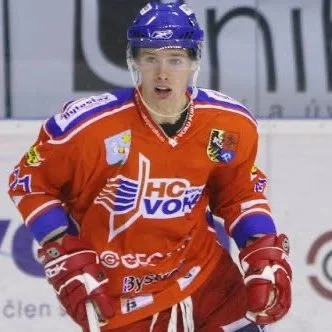
Mocek as young player with hometown club HC Vítkovice
He is not only being asked to help coach the national team, instead he is being asked to help build stronger connective tissue across the entire Czech women’s hockey pathway, ranging from youth development, coaching education, domestic competition, national team methodology, and the long-term player pipeline. For a country that has already proven it can compete with the world’s best, the question now is different than it was several years ago. “Can Czechia break through?”…is no longer the right thing to ask. Now, it’s “How does Czechia stay there?”
Mocek’s hockey story began in Ostrava, a historically significant old steel manufacturing city in the historic Czech region of Silesia, where he grew up in a hockey family and came through HC Vítkovice as a junior player. His playing career eventually took him to North America after he was drafted into the Canadian Hockey League and spent time in the Quebec Major Junior Hockey League (QMJHL) with Val-d'Or and St. John’s. Despite a short stint in Canada’s premier youth competition, his path kept moving. There were stops back in Europe, including Great Britain, which Mocek said exceeded his expectations as a hockey experience. There were more years back in Czech hockey. Eventually, there was another opportunity in North America, this time in the United States, where he played minor professional hockey in the Federal Hockey League (FHL) before a friend helped pull him into coaching youth hockey in New York City, a step that changed the direction of his life.
Mocek fell in love with New York City (where he still resides), but he also fell in love with coaching. What began as a way to stay around the game became something much larger. His time in New York eventually led him to North Park Hockey, Chelsea Piers, and the wider youth hockey environment in the city which he became ingrained in, forming a professional and experienced reputation. It also put him in proximity to a women’s professional hockey opportunity that would become one of the defining chapters of his coaching career. Through another friendly connection, Mocek was given the chance to interview with the Metropolitan Riveters, then of the NWHL/PHF.
At the time, he said, he knew about the league and had followed it from a distance, but he was not fully immersed in the women’s professional game yet, but that changed quickly. The Riveters became Mocek’s first real exposure to professional women’s hockey at a level that included professional, NCAA Division I, and international-caliber players. The league itself was trying to grow, resources were limited, and the infrastructure around women’s professional hockey was not where it needed to be. Players were still fighting for the basic support, visibility, and standards that the women’s game deserved. But what Mocek found inside that environment made an immediate impression.
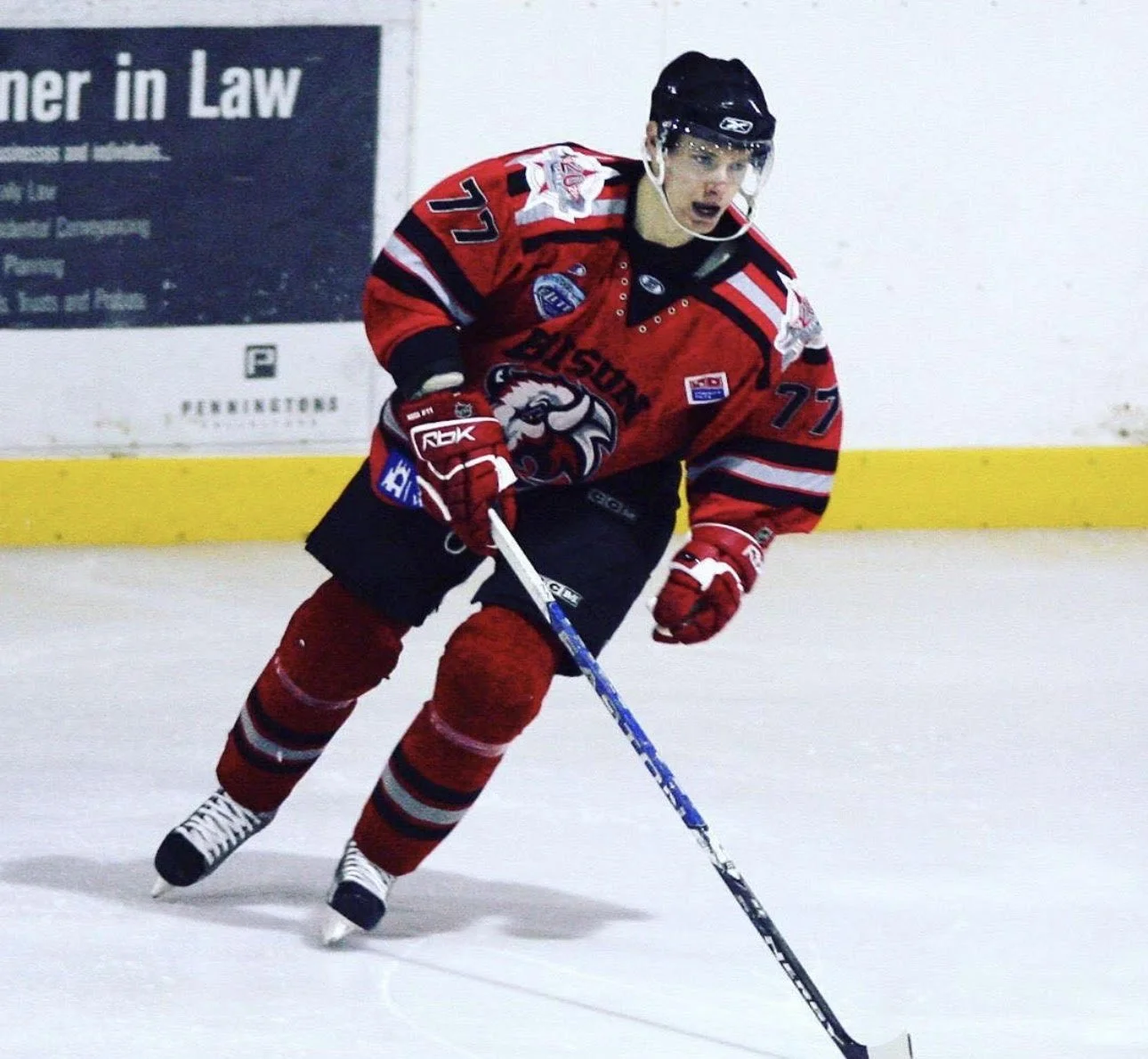
Mocek playing with the Basingstoke Bison of the EIHL
“The players wanted to be pushed and coached like hockey players - women or not,” Mocek said. He saw players who wanted more. More coaching. More resources. More structure. More opportunity. More chances to learn how to win. That was different from some of his earlier experiences in hockey. It was not entitlement, but rather it was drive. The players were trying to build something while also competing inside it.
“They were hungry to succeed,” Mocek said. “There was a drive.” For Mocek, that became deeply motivating. Women’s hockey was still trying to find its place, but the players themselves made clear where they wanted the game to go. Mocek spent nearly five years around the Riveters organization in different roles, including head coach and later associate head coach. When the PHF/NWHL era ended and the PWHL launched, Mocek had hoped there might be an opportunity to remain in the North American professional women’s game. But the new league moved quickly. Coaching decisions and shortlists were formed early, and eventually it became clear that a PWHL opportunity would not materialize at that time.
After the Riveters, two players he knew went to China rather than the PWHL. One of them, a Finnish player, recommended him for a coaching opportunity. Soon after, Mocek was headed to China to coach KRS Shenzhen (otherwise known as Kunlun Red Star). On both a personal and hockey level, he described the experience as an extremely valuable moment in his career. It gave him another perspective on international women’s hockey, player development, and what it means to build a team in a completely different cultural environment. It also kept him connected to the international game, acting as a consultant to the Chinese National Team.
These experiences, both in the former NWHL and in Asia have given Ivo a chance to see sides of the sport many never get a chance to witness. Since Mocek first entered women’s professional hockey, he has seen major changes in the sport. Two stand out most to him, the first is physicality. He pointed specifically to board play, corner battles, and how much more demanding those areas of the game have become over the years. The women’s game has always had pace and skill, but the modern version is increasingly physical in ways that require players to be stronger, more prepared, and more comfortable competing through contact.
The second major change is depth.
“In the earlier NWHL years…”, Mocek said, “…teams often had a small group of high-end players at the top of the lineup, followed by a noticeable drop-off in talent. That is not nearly as true anymore, now, the talent pool is deeper. More teams can roll multiple lines. Most top-tier countries have players who can contribute throughout the lineup. More rosters are built not just around stars, but around complete groups of players up and down the lineup.”
He pointed to Switzerland as one example from recent international competition at the Milan Olympics (where they captured a Bronze Medal). What stood out to him was not simply one or two elite players, but the team’s depth across the lineup and the way that depth contributed to their success. Czechia already has star power, and it has elite goaltending. It has a leadership core that has helped define the program’s most successful era. But to remain among the world’s best, Czechia will need more than top-end talent. It will need layers, depth, and a system that can continue producing players capable of stepping into international hockey and contributing in meaningful roles. That is where Mocek’s new job becomes especially important.
Ask Mocek how his players would describe him, and he does not hesitate. Demanding, but fair. “I require the best out of my players,” he said. “But they know there is intention behind what I do.” For Mocek, demanding standards only work when they are paired with communication and transparency. Players need to know why they are being challenged. They need to understand the purpose behind the pressure. A coach’s job is not simply to dictate, but to help players in whatever way they need in order to improve. That belief was shaped partly by Mocek’s own playing experience. He remembers moments, especially in junior hockey, when communication between coaches and players was almost nonexistent. As a player lower in the lineup, he described the experience of not knowing whether he was playing until he walked into the locker room and saw whether there was a jersey waiting in his stall. Those experiences left an impression. Now, as a coach, Mocek places a premium on clarity. Players may not always like every decision, but they should understand why decisions are made and what is expected of them.
He also believes practices must reflect the game itself. “I’m a big believer that everything you experience in a game, you must experience in practice,” Mocek said. That means smart practices that blend competitiveness and situational learning. Practices that prepare players not just to skate through drills, but to solve the same problems they will face when the game is on the line.
Mocek’s communication style has also been shaped by the range of players he has coached. In New York, he worked with very young players and adult recreational players. He joked that the difference between coaching an eight-year-old and a 60-year-old is enormous, but that experience helped him learn how to teach. “Every coach…”, he said, “…should spend time coaching young players.” It forces coaches to explain the game clearly and forces them to simplify without dumbing things down. Mocek believes coaches need to understand whether players truly know why they are being asked to do something.
That lesson has only become more important with the current generation of players.
“This generation requires more information,” Mocek said. “Young players are more willing to ask questions. They want to understand the purpose behind a drill, a system, a role, or a correction. They are not as likely to accept “because I said so” as an answer.”
Mocek does not see that as a problem, and he sees it as a major part of the job.
As a coach, he believes you need to be able to explain the why. If you cannot explain it, you probably should not be asking for it. That philosophy will matter not only with the senior national team, but also in his broader development role. Creating a national hockey identity is not just about handing coaches a playbook, but more helping players and coaches across the country understand the same language, the same standards, and the same developmental priorities.

Mocek as Head Coach of the Metropolitan Riveters (NWHL/PHF)
One of the clearest themes from our conversation with Mocek was the development gap between North America and Europe. In his view, North America remains far ahead when it comes to girls’ hockey development. There are simply more layers. Girls in North America often have access to girls-specific programs, tiered club structures, prep schools, academies, high-level youth competition, college hockey, and now an increasingly visible professional pathway through the PWHL.
Europe has talented players. Czechia absolutely has talented players. But the development system is not yet as layered or opportunistic. In Czechia, talented girls have often followed one of two paths: continue playing with boys for as long as possible, or leave relatively early for stronger girls’ and women’s environments abroad. For some elite players, that has worked perfectly. Czech players have developed in Sweden, Finland, North America, and elsewhere, and many of those experiences have helped fuel the national team’s rise.
But Mocek does not believe Czechia can rely on that forever. Some people argue that playing with boys helps girls develop because of the speed and physical demands. Mocek understands that argument. But he also pointed out something important. At the World Championship and Olympic level, Czech players are not competing against boys, they are competing against other elite female players. Czechia needs more spaces where girls can develop together, compete against each other, and grow inside a structure designed for them.
The launch of the Future Olympians U16 league this past season was an important step. Mocek sees it as part of the foundation, but not the finish line. He mentioned the hope that local U14 programming can continue to grow, and he also pointed directly to the need for another layer above U16. “The natural step would be to have a U19 program as well,” Mocek said, “…to prepare players to jump into those pro leagues.” The leap from youth hockey to professional women’s hockey can be steep. Too often, talented Czech players are identified early and then pushed into adult environments before there is a true middle stage of development (we see this time and time again in Sweden/Finland/Switzerland). A U19 structure, stronger domestic competition, and eventually more opportunities tied to education could help solve that.
Mocek also mentioned the growth of Czech university hockey, especially on the men’s side, as a project he admires. The marketing, federation involvement, and structure around it have shown promise. His hope is that women’s hockey can eventually build something similar. Because if Czechia wants to retain more players, develop more players, and widen its national team pool, it needs more than elite exceptions, it needs pathways.
This is why Mocek’s new role within Czech hockey becomes critical. His role with the senior national team is important, but his broader responsibility may be even more significant. “I would say my main role is to further the development of girls’ hockey nationwide,” Mocek said. “But you can only do that if you have qualified coaches.” For Mocek, growing the game starts with coaching. Czechia needs more coaches working with girls. It needs better support for those coaches. It needs education, resources, and a shared understanding of what the country wants its players to become. He wants to work closely with coaches around the country to help provide a better youth hockey experience for girls, because keeping players motivated depends heavily on the quality of their daily environment.
That also applies to the domestic women’s Extraliga. Mocek was clear that the Czech women’s Extraliga is not yet at the level of leagues in Sweden, Finland, or Switzerland. But he also emphasized that many young players are playing there, which makes the league important. If the federation wants to show that there is a path from the domestic league to the national team, then the domestic league needs attention, resources, and belief. That path already exists in examples like Viktorie Jílková (who is a multi-sport talent, one of the premier boxing champions in the country) and Karolína Kosinová, players who have shown that development inside Czechia can still connect to national team opportunities. But for that to become more common, the environment must improve.
Mocek used one phrase that may define his vision more than any other: unified hockey language. “We need to come up with a unified hockey language across the board,” he said, “across the entire women’s hockey architecture in the country.” That does not mean every team has to look identical, nor does it mean U16 players and senior national team players should be coached the exact same way. But it does mean the system should be connected. The terminology, habits, standards, and expectations should all connect. A young player entering the U16 structure should begin learning the same broad principles that will matter at U18 and, eventually, with the senior national team. That is how countries build sustainable development systems.
………………………………….
One of the most interesting parts of our conversation came when we discussed the role of Czechia’s major hockey clubs. Across Europe, many of the strongest women’s hockey environments are attached to major legacy clubs on the men’s side. In Sweden, clubs like MoDo and Brynäs have women’s programs. In Finland, clubs like HPK and TPS have women’s teams. In Switzerland, major clubs have also invested in women’s programs. But Czechia has not developed that same culture as broadly. That is something Mocek wants to help change.
The big Czech clubs have infrastructure and the have facilities, with legitimate coaching resources. Many have academy status and long histories of developing players on the boys’ and men’s side. Some are producing male players who leave for Canadian junior hockey, the CHL Import Draft, and other international opportunities. Mocek understands why those clubs have traditionally invested most of their resources into boys’ and men’s hockey. That is where the established structure, finances, and cultural attention have been.
But women’s hockey is changing. The PWHL exists now, and more Czech players are reaching elite professional environments. More girls are entering the sport, and the national team has already proven that Czechia can compete for medals. If Czech hockey wants to keep pace, Mocek believes the domestic club structure needs to evolve too. He mentioned clubs like Karlovy Vary and Pardubice (both Extraliga clubs) as examples of organizations that have shown real effort to make something happen. But the larger goal is broader than one or two clubs. He wants more legacy organizations to understand that girls’ programs are not charity projects. They are long-term investments in the future of Czech hockey.
We also discussed the example of Czech football, where major clubs like Sparta and Slavia have put significant resources into their women’s programs and seen that investment produce results. Mocek hopes hockey can follow. The message he wants clubs and organizations to hear is that the federation cares about women’s hockey and wants to help create the conditions for growth. It is not enough to assume that talented girls will play with boys for as long as possible and then leave the country to find their next stage of development. Czechia needs to give them more reasons to stay.
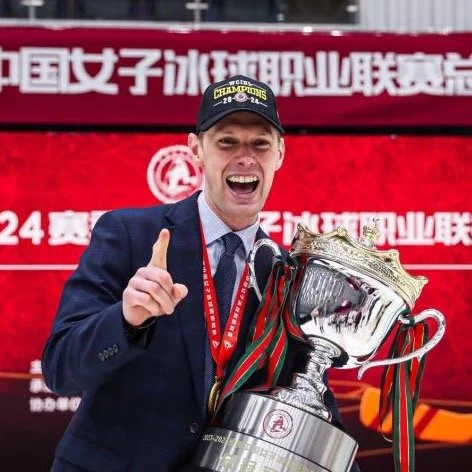
Mocek as Head Coach of the Shenzhen KRS (WCIHL) - ‘23-’24 League Champions
Of course, none of this is happening from the ground floor. Czech women’s hockey has already reached historic heights. Under previous head coach Tomáš Pacina, the program developed important structure and standards. Under Carla MacLeod, Czechia added a new level of belief, culture, energy, and international success. The senior national team won historic medals and changed how the hockey world views Czechia.
Mocek spoke with respect for both of these eras. Pacina, in his view, helped establish a certain structure and playing identity, and MacLeod then brought the right kind of positive energy at the right time. “Carla brought a positive mindset,” Mocek said. “And that positive energy is so important.” He emphasized that players want to feel supported. They want to feel wanted, to know that the staff believes in them. That part of MacLeod’s legacy is something Mocek wants to carry forward. But he was also honest about where the program is now.
The medal breakthrough was real. But over the last couple of years, Mocek believes the program has plateaued. NOT that it has failed, but that the next step requires something different. “We need to add another layer,” he said. “We have to push it farther now.” That next layer will be about more than emotion. It will require systems, structure, depth, competition, and a broader player pool. And it will also require urgency. Czechia’s current leadership core has been outstanding. Players like Aneta Tejralová, Kateřina Mrázová, Klára Peslarová, and others have carried the program through its most successful era. But they cannot be relied on forever, Mocek knows that.
The program has a strong group of players in their late 20s, early 30’s. There is another important group behind them, including names like Natálie Mlýnková, Kristýna Kaltounková, and Noemi Neubauerová. And behind them, there is a young generation coming that the federation is excited about.
The challenge is connecting those groups before the current core ages out. Bright days may be ahead, but they need to be built intentionally.
……………………………………….
Mocek’s new role also connects him with Brian Idalski, the new head coach of the Czech women’s national team. Mocek first connected with Idalski through China, where Idalski had coached the Chinese women’s national team and later worked in the professional game. Mocek described Idalski as helpful and supportive when he was preparing for his own China experience. Now, they will work together with Czechia.
Mocek pointed to Idalski’s broad background as one of his biggest strengths. He has coached in the NCAA, internationally, at the Olympics, in China, and in the PWHL. “Brian is going to help take us to the next level because of the variety of experiences he’s had in his career,” Mocek said. He also believes they see the game in similar ways. “I think we see things the same way,” he said. “We both have the same culture we want to build and get out of these players.”
When camp begins, Mocek said one of the first priorities will be getting familiar with the group. But that does not mean simply preserving the status quo. The staff wants to challenge the established players and wants veterans to help bring younger players into the mix. It wants U18 players and emerging players to understand that spots are available, but only if they earn them. The message will be clear. “No one is here just because you’ve been here in the past,” Mocek said. That is not meant as a threat, but it is meant as a standard. The older players need to be pushed. The younger players need to be hungry. The environment needs to create healthy competition, because the national team needs to avoid becoming comfortable. For a program trying to move from breakthrough to sustainability, comfort is the enemy.
When asked what meaningful progress would look like over the next Olympic cycle, Mocek answered in two parts.
The first is the senior national team. Czechia’s goal, in his mind, should be clear: establish itself as the best program in Europe. “There’s no other alternative, full stop.” Mocek said. That is an ambitious standard, but it reflects where Czechia now sees itself. The program is no longer satisfied simply being respected. It wants to contend for medals and to regularly challenge and beat the best teams in the world.
But the second part of Mocek’s answer may be even more important. At the developmental level, success means growing the girls’ program nationwide, continuing to build the Future Olympians structure, and giving players and coaches more resources. Changing the culture around women’s hockey in Czechia is the goal. But it also means convincing more large and legacy clubs to invest real energy, time, and resources into girls’ programs. Czechia cannot rely forever on the idea that its best girls will play with boys, leave the country, and somehow return as finished national team players. That has produced some excellent players, but it is not enough as a long-term national strategy.
…………………………………..
Ivo Mocek has returned to Czech hockey at a moment when the women’s game is asking bigger questions of itself. The federation has acknowledged that women’s hockey development needs more structure, more resources, and more intentionality. Mocek’s job sits right in the middle of all of that. He is an assistant coach for the National team, but he is also a builder, connector, translator, and organizer, someone who understands Czech hockey, North American development, women’s professional hockey, and the need to create a shared language across an entire system. His path back to Czechia began the same way much of his career has unfolded, with an opportunity. This time around, the opportunity belongs to him, and to Czech women’s hockey as it continues to evolve, one season at a time.
