The Right Ending: Viktorie Švejdová Leaves the Crease To Guide The Next Generation
There is a kind of ending athletes are rarely allowed to have in sports. Too often, the game decides that ending for them. Rosters change, bodies break down, and sometimes roles disappear. A contract never becomes what it was supposed to become. A career that once felt endless suddenly becomes something to explain. Viktorie Švejdová knew deep down all those versions were possible. For years, she thought injuries might be the thing that finally made the decision for her. Concussions. Back issues. The accumulation of a life spent in the crease, where the body is asked to absorb everything that everyone else is trying to avoid.
After a season that began with frustration at HV71 and ended with a late-career revival at Rögle BK, the former Czech national team goaltender has stepped away from playing at 23 years old. Not because the game had left her behind or because she could no longer perform. In fact, the final evidence says the opposite.
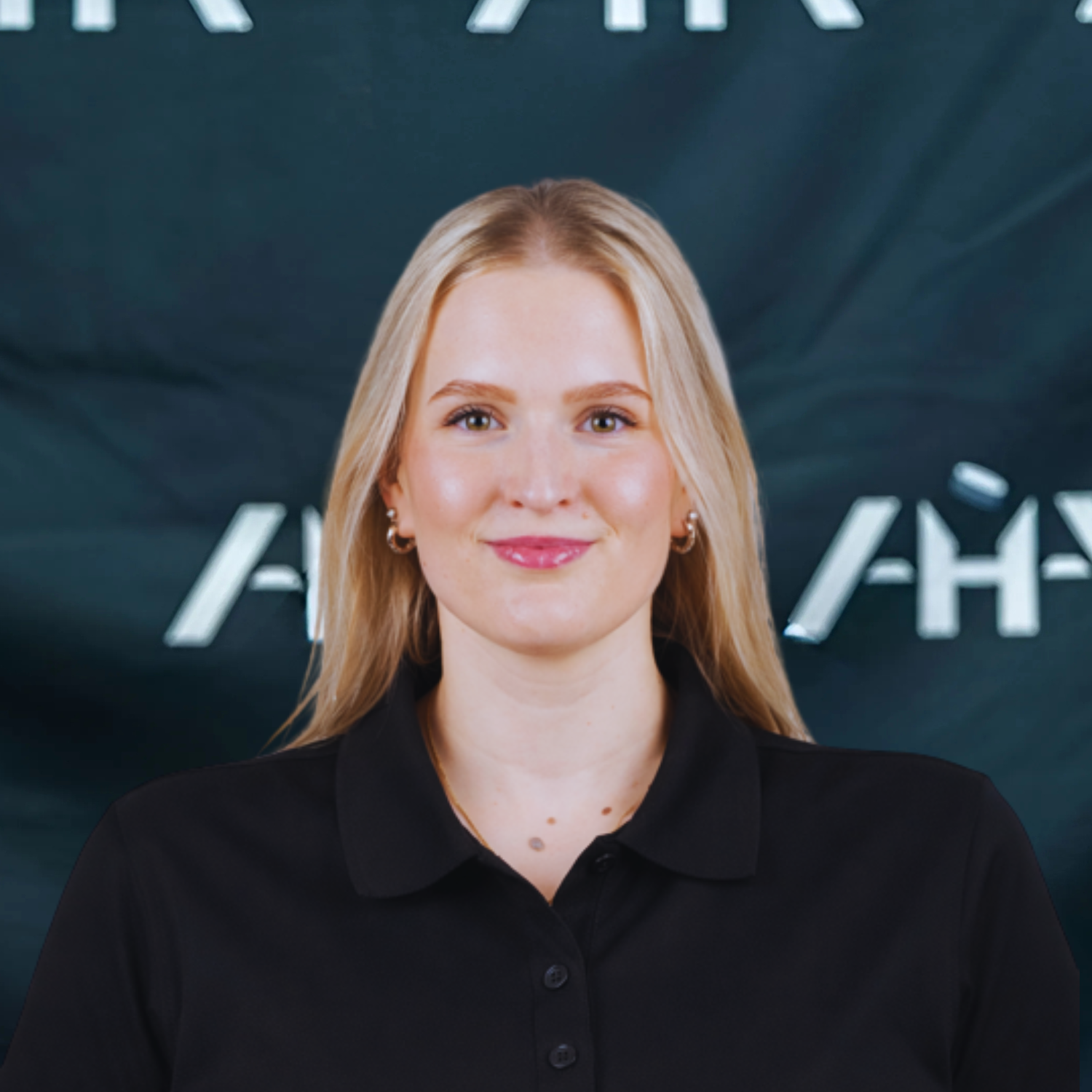
Švejdová’s headshot as an advisor for Women’s Advancement Hockey Advising.
Švejdová arrived in Ängelholm in late November, signed for the remainder of the season, and helped steady a Rögle team chasing its way toward the SDHL. In HockeyAllsvenskan South regular-season play, she finished with a 1.42 goals-against average, a .9486 save percentage, two shutouts, and a 12-2 record across 14 appearances. When Rögle clinched its semifinal series against Örebro, she stopped all 31 shots in a 3-0 win that sent the club into the NDHL final and SDHL qualification stage. Her performances were the type of finishes that make any athlete put retirement far away from their ming. For Švejdová, it made the ending feel possible.
“There were so many things happening at once. And somehow, they all happened at the perfect moment.”
Her final year had not begun that way. She started the season with HV71, where she felt the situation never became what had been promised. She is matter-of-fact about it now, in the way veteran hockey people often are. It was hurtful and frustrating. But it also happens. Then came Rögle.
“I got to Rögle and within a week I told the coaches, I am not leaving. I felt so happy there. After struggling earlier in the season, it was amazing.”
She knows the line can sound like the kind of thing players say after the fact. But in this case, the cliché was true. Rögle gave her something she had been missing.
“It sounds cliché, but I had never been part of such a great organization before in my career. I just wanted my last memories to be with the best people.”
In our conversation, Švejdová didn’t appear to care as much about the statistical revival of her game as much as she cared about the emotional one. She did not rediscover only her game and the kind of goalie she knew she had always been, but instead she was able to rediscover joy in the sport she loved.
“I had fun at practice again. Even if I was on the bench, I was still happy. Once your head is in a good place, everything becomes easier.”
At Rögle, she also found a goaltending environment she valued from the club, including a strong tandem and relationship with Alba Gonzalo. She found younger teammates who wanted to learn, a room where her experience mattered, and a club where she could be more than a goaltender fighting for starts. She could be a leader, a role that suited her.
---------------------
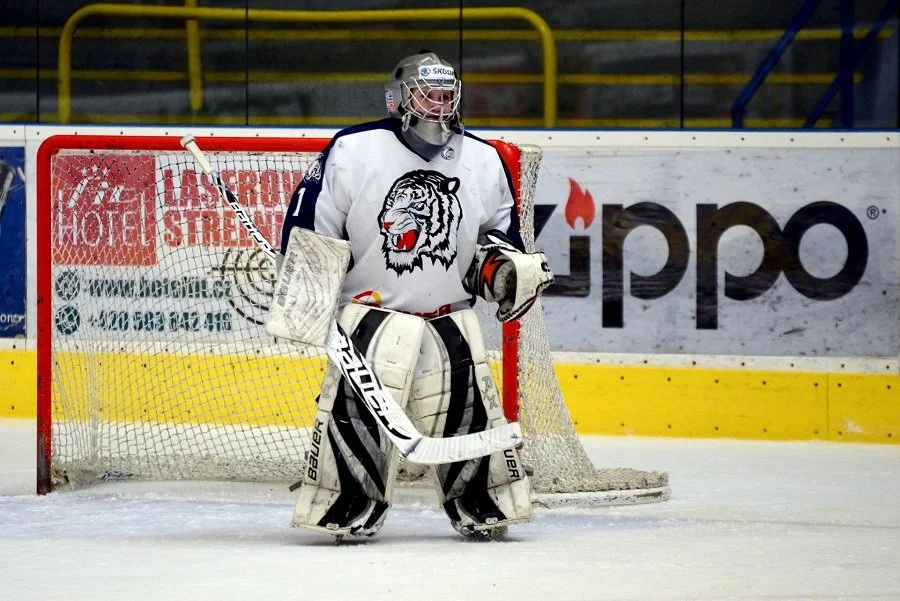
Švejdová playing for Bílí Tygři Liberec.
Long before Rögle, there was Liberec.
Švejdová grew up around Czech side Bílí Tygři Liberec. Her father had played hockey when he was younger, brought her to the rink, and helped introduce her to the game. She was skating as a little girl and found her way into the net around age six. By 13, she was already being profiled as one of the most promising young goaltenders in Czech women’s hockey, playing with boys, appearing for the women’s side, and earning opportunities in the Czech youth national team setup. The ambition was there early. But so was the reality of the environment around her.
“I was on one of the best teams in Czechia back then, but coaches started telling me, you are a girl, you cannot play here forever. You need to start looking for where you can expand.”
The Czech women’s game has grown dramatically since then, but at that point, Švejdová felt boxed in. The domestic pathway did not yet match what she believed she could become.
“I thought I had a lot more to give the sport. This was not it. This was not the level I deserved to be playing at.”
So she started searching. Not through a formal recruiting pipeline or a modern agency network, but through the early, messy, very human version of hockey networking which included Facebook messages, word of mouth, and people trying to find people. Eventually, MODO Hockey came into the picture. A contact from the Swedish club reached out and offered a tryout. Her father traveled with her. Her parents, she says, were doing the heavy lifting to help fund and support the next step in her career. At 15, she left home for Sweden.
“I thought I had good English before I went to Sweden. Then I got there and realized they spoke it much better there. I was not ready for that trip!”
She made the team anyway. And in many ways, Sweden became the place where her hockey identity fully formed. MODO became home for five years. The training was deeper. The goalie development was more frequent. The environment asked more of her, not only as a player but as a young person living far from home. It was novel, she says, for a Czech player to leave the country that young. But it also felt right almost immediately.
“It was the perfect fit. I knew this was what I wanted. I knew pretty early that college was not the path for me yet. Hockey was it.”
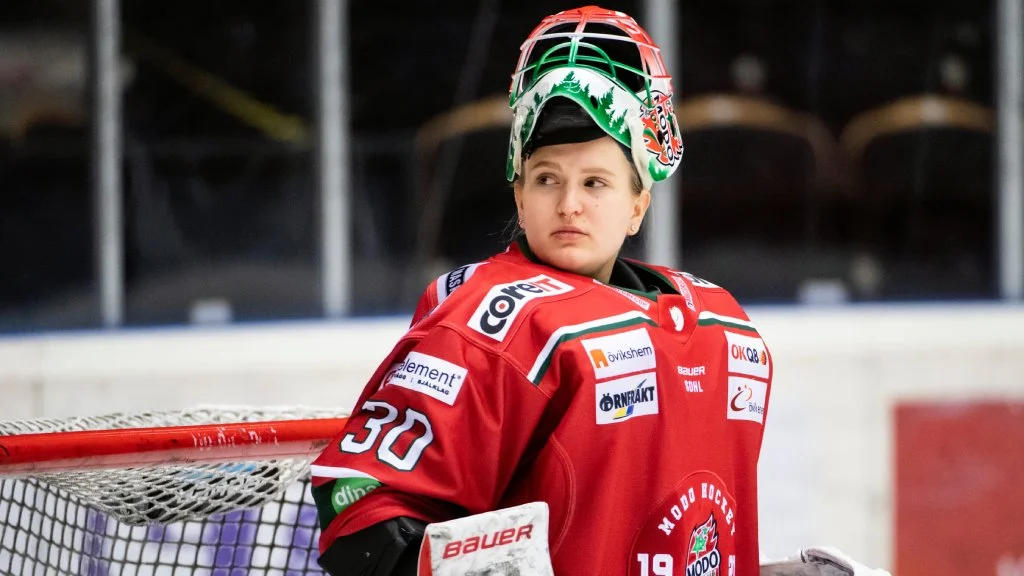
Švejdová as a young player with MoDo
That decision shaped everything that followed, her SDHL career, her national team ascent, her language skills, her independence, and now her next career. To understand why she wants to guide players, you have to understand that she once had to find her own way into a new country, a new league, and a new version of herself. Goaltenders live with a different kind of pressure, one where the position is public solitude and everyone can see the mistake. No one can hide the results, and a goalie’s work is measured in tiny failures of geometry, timing, traffic, and patience.
Švejdová learned early how emotional the position could make her. As a young goalie, losses hit hard. Over time, she became calmer, more controlled, more able to separate the moment from the person living inside it.
“I am pretty calm when it comes to hockey. It has always been easy for me to stay cool on the ice. That is a big part of my game. In my personal life, I am definitely more chaotic.”
That calm now carries into her new role with Women’s Advancement Hockey Advising, where she is beginning work as an advisor and agent. For now, much of her focus is on import players coming into Sweden. It is a niche she knows intimately. Import rules are tightening in Sweden and elsewhere in Europe. For players trying to find the right fit, especially from outside the country, the uncertainty can become overwhelming. Švejdová understands that anxiety. She also understands the limits of worrying about what cannot be controlled.
“I try to tell players there are things you can control and things you cannot. As goalies, we are good at not worrying about things we cannot affect.”
That might become one of her advantages as an advisor. She is not entering the player-representation world as someone who watched the pathway from a distance, instead she lived it from the player side. Foreign rinks and new languages, new cities, the promises that clubs make and the uncertainties that come with every new season, the pressure to perform before you fully feel settled. When she describes the advisor she wants to become, she does not begin with contracts. She begins with presence.
“I would love to be an advisor who is present. If an import comes from outside Sweden, it is good to have someone who knows the place, who can give advice, and who is available.”
Then she put it in simpler terms.
“I want them to know I value them as a person more than as a player. Like an older sister who has been there and done that.”
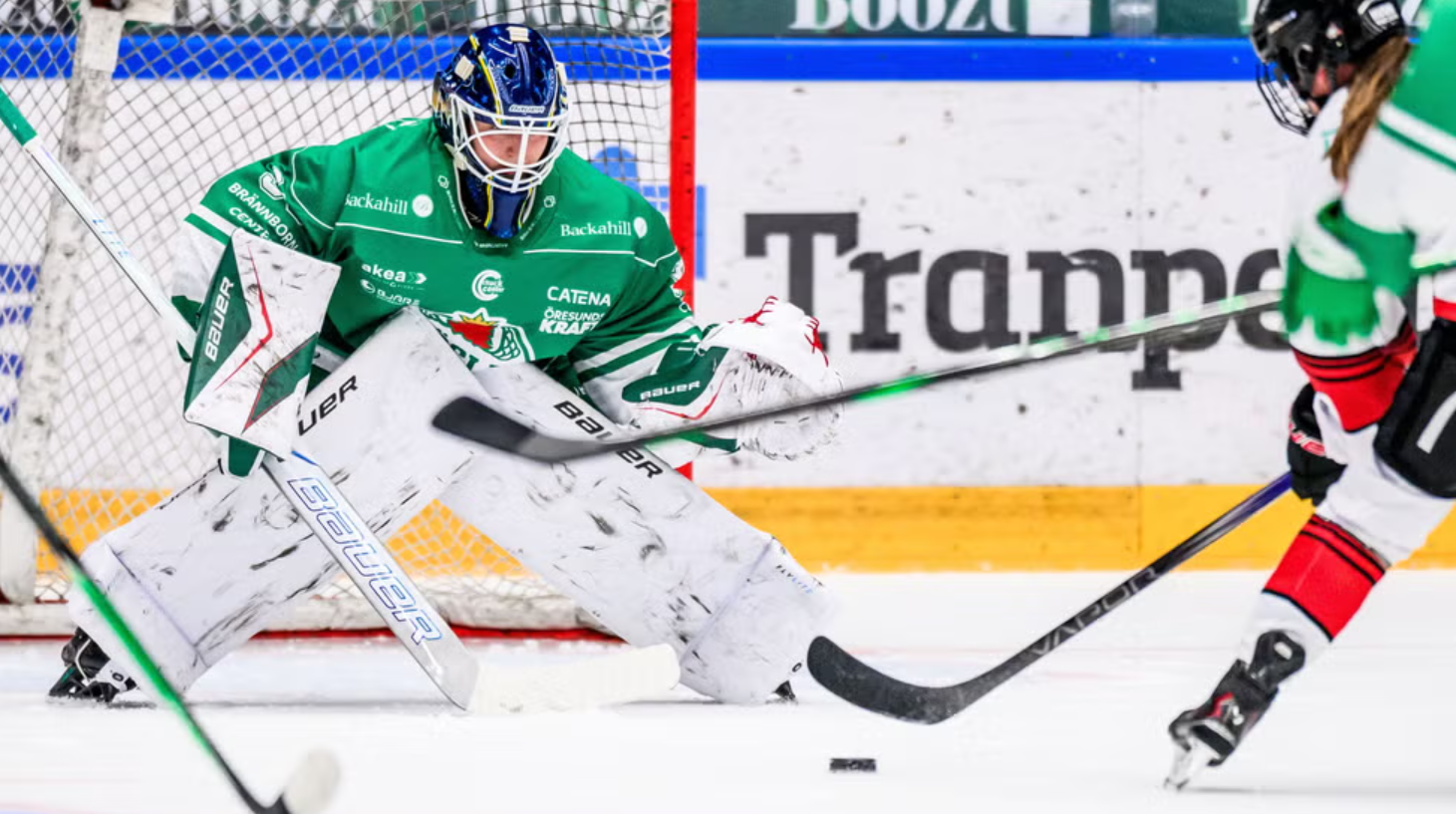
Švejdová with Rögle in her final season.
There are not many goalie agents in women’s hockey. There are even fewer who can speak from inside the Swedish system, inside the Czech national program, inside the Olympic environment, and inside the daily emotional life of the position itself. That is why the next chapter for Viki feels less like a clean break away from hockey and more a change of vantage point. Švejdová is not leaving hockey but instead is moving to the other side of the conversation. The transition had been building before the retirement announcement. Švejdová is studying in Sweden, in a program connected to sport management and dual careers, with two years still to complete. She had coached goalies for years and had also worked around teams as an assistant coach. But coaching, she realized, was not quite the thing she wanted her future to be.
“Last year I was thinking, what am I going to do after school? I have been coaching for so long, goalie coaching in Sweden, assistant coaching, but it was not really the thing for me.”
Her friends nudged her toward representation. You know so many people, they told her, and you have been in Sweden so long! You are talkative and kind and personable, and you understand the player side. Then came the connection with WAHA, where Danielle Stone and the team were looking for someone who could work with goaltenders.
“They said, we are looking for someone to be an agent for goalies. I was worried I would not be able to do it, but they said they would help me. It was a good coincidence. It is life. Sometimes things work out.”
The fit makes sense because Švejdová’s own career was shaped by navigation. She knows what it costs families to chase opportunity. She knows what it feels like to arrive in a new country and need help with things that are not strictly hockey, and she knows the difference between an advisor who is technically available and one who is actually there for her clients. She also knows the financial reality of women’s hockey still needs to change.
“The PWHL has done it with good pay and good conditions. But if you look at leagues like the SDHL, it is crazy how little money players make and how badly they can be treated still, even today. It is across the board and doesn’t discriminate, national team players, top scorers, everyone. That part of hockey is still taboo, and it has to get better.”
She is careful to acknowledge the progress. When she first left home, there was little money in the women’s game. Her parents funded her early years. The sport has moved forward but progress, to her, cannot become an excuse for satisfaction.
“As an agent, you cannot be satisfied. You have to try to push for more. If we all push, at some point people will have to do something.”
It is a striking perspective from a player who is only 23, but Švejdová has been living in senior hockey spaces since childhood. She debuted with the Liberec women as a child, left home at 15, spent a decade around Czech national teams, and played professionally in Sweden for six seasons. Her age says one thing, and her experience says another. Ask Švejdová what she is proud of from her national team years, and she does not immediately reach for medals, she reaches for people.
“I am more grateful than proud. Grateful for the friendships and relationships I made. But I am proud of the impact we made.”
That impact is difficult to separate from the rise of Czech women’s hockey itself. When Švejdová came through the system, she says many people in Czechia did not even know there was a women’s national team. Now, young girls can see Czech players in the PWHL, NCAA, SDHL, NDHL, and international tournaments. They can see Olympic appearances, World Championship medals, and home crowds that make the sport feel visible.
“When I started, not a single person knew about us. People around Czechia did not even know we had a national team. Now the most important thing is how many smaller girls and kids can see how fun it is to play and be part of it.”
Her involvement did not stop at the senior team. Švejdová also worked with young players through early girls’ hockey development efforts, including Holky na led and the Future Olympians program in its infancy. She remembers coaching little girls at camps and later seeing some of them grow into players she would face in Sweden. That full-circle feeling is so very important to her. The national team was not only about tournaments, but it was also about showing a generation what could be possible down the line. That was part of what made the 2025 Women’s World Championship in České Budějovice so emotional. The tournament ended painfully for Czechia. But the scene around it - the visibility, the attention, the young fans in the building - was still powerful.
“It was so sad. But it was also amazing. All those small kids could see what is possible. They could watch and learn and be inspired.”
For athletes, legacy can be an uncomfortable word. But in Švejdová’s case, the legacy is not only in the games played or medals won. It is in the Czech girls who now grow up knowing there is a path at all.
Retirement is not clean just because it is chosen though. Švejdová is still processing it now that the season is over. She expects it may feel different when the offseason rhythms begin and she is not part of them in the same way. Her boyfriend, Czech goaltender Jan Bednář, will start his summer work. She will not be doing the same.
“It will probably hit me in a couple of weeks when my boyfriend starts doing off-ice workouts and I do not. But it will also be kind of nice.”
Bednář, a Czech goaltender who played this season with Ässät Pori in Finland, is part of the next chapter too. Švejdová is moving to Pori, her first time living outside Sweden since she left Czechia as a teenager. She will continue school, keep building her work with WAHA, and support his career as they build a more settled life together. For someone who describes herself as a planner, the uncertainty is both strange and liberating.
“I plan every single second of my day. I am very specific about things in my life. But with life, you have no idea where it will take you. I just want to have fun, settle down with my boyfriend, be there for his career, be there for each other, and take life as it comes.”
A somewhat peaceful answer, one that Švejdová said to me confidently and decisively. For years, Švejdová thought the ending might come because her body finally said no. Instead, she got to decide. She got to leave after finding joy again and to leave with a locker room she loved, a club that gave her back some of the feeling she had been missing, and a final stretch that confirmed she could still play at a high level.
“At the end of the day, it was my decision. I thought for years it would be injuries that decided it, but I got to do it on my own terms. I will miss the locker room of course. I will miss that so much. It is not about the games. It is the people you meet.”
Viktorie Švejdová is leaving the crease, (and as a goalie myself I can only imagine the feeling knowing that part of the world is behind me). But she is not leaving the people. She is not leaving the younger players that are trying to cross borders, learn leagues, survive uncertainty, and build careers in a sport that still asks women to fight for more than they should have to. After 19 years as a player, she is turning toward the next generation with the perspective of someone who had to grow up quickly in the game and is now determined to make that path feel less lonely for someone else. Through this decision, she has truly found the right ending for herself, and now she is trying to help others find their beginning….for now.
*(Writers Note: Viktorie has been one of our most responsive and biggest supporters of our platform. We are more than thrilled for this next chapter in her career, and while we are saddened we won’t see her on the ice anymore, we look forward to having her unique perspective on the women’s game in future articles, interviews, and content as we grow our community of athletes who bring so much unique perspective to the game. Děkuji ti, Viki, a hodně štěstí!)
